

Employees of CI-Engineers have been involved in the Oosterweel project for quite some time, one of the largest infrastructure projects in Belgium. This major project aims to significantly improve mobility around Antwerp, including by completing the Antwerp Ring Road through a new connection between the left and right banks of the River Scheldt.
During the initial phase of our involvement, our focus was on the immersed tunnel of the Scheldt Tunnel. Here, we applied advanced Revit techniques to produce reinforcement drawings and automated various processes using Dynamo scripts, including reinforcement numbering and the generation of bar bending schedules. The tunnel consists of eight immersed tunnel elements, each made up of 20-metre sections. These elements are constructed in Zeebrugge and subsequently transported to Antwerp.
More recently, our activities have shifted to the OKA area (Albert Canal Crossing), particularly the southern section, OKAZ. This crossing is being constructed by temporarily creating a dry working area within the Albert Canal using a polder structure consisting of sheet pile walls and a dewatering system. Within this polder, diaphragm walls and CB walls are constructed, which will later form part of the permanent tunnel structure.
The tunnel itself consists of four stacked rectangular tunnel boxes. The two lower boxes provide connections towards the Netherlands via the A12/E19, while the two upper boxes connect towards Antwerp’s Sportpaleis and the E313.
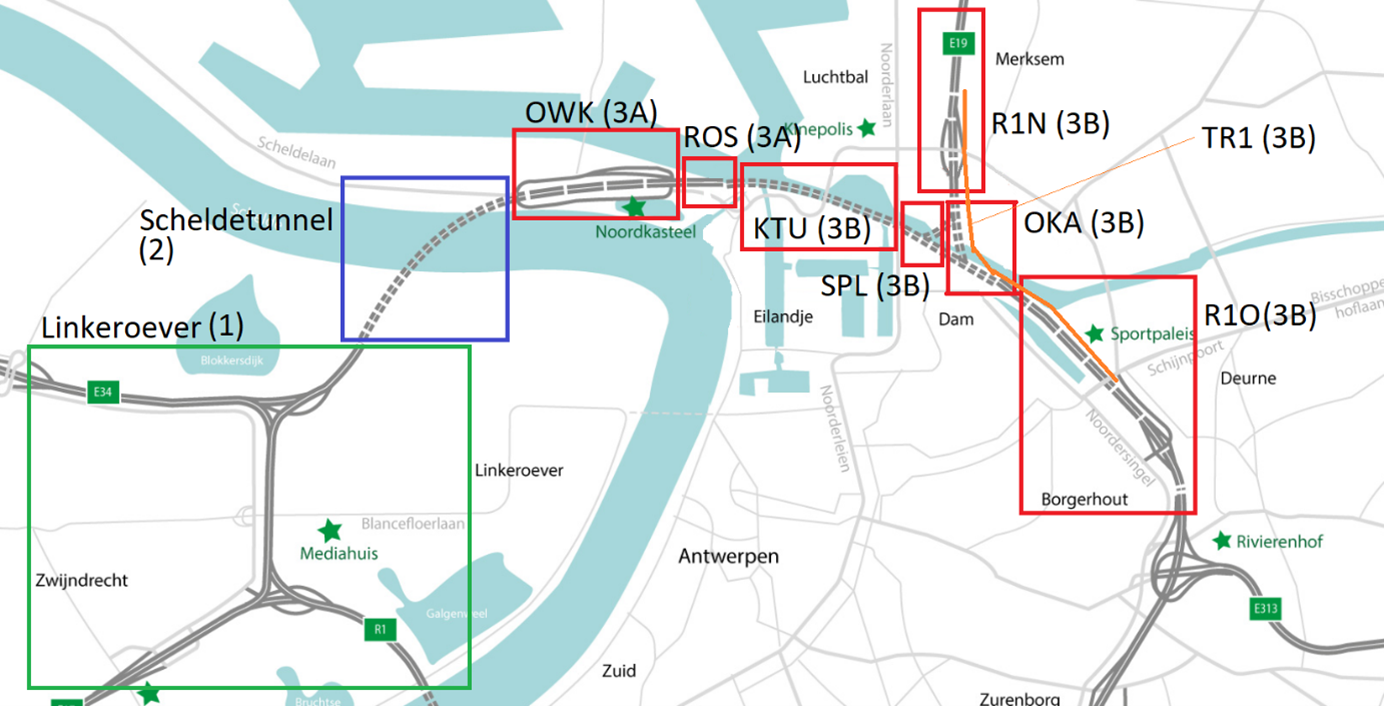
As structural engineers, we make an important contribution to the design and structural calculations of the struts, bracing frames and waling structures with tie-back anchors within the OKAZ section. These elements are crucial for ensuring the temporary stability of the deep excavations. Our focus is not only on structural reliability, but also on constructability and straightforward detailing.Within the OKAZ project team – led by Royal HaskoningDHV – we work closely with geotechnical engineers, BIM modellers and draughtsmen, both internally and externally.The Oosterweel project is divided into five main sections, including a new 1.8-kilometre Scheldt Tunnel with three traffic lanes in each direction and a separate cycling tunnel.The entire project is expected to be completed in 2030.
Client: Lantis
Contractor: ROCO